Climb the winding stone paths of Nakijin Castle Ruins and you’re walking into the heart of a vanished kingdom. Long before Okinawa unified under a single royal house, this hilltop fortress on the Motobu Peninsula was the seat of the Hokuzan king, ruler of the island’s entire northern half — and at 1.5 kilometers of undulating wall, it was once the second-largest gusuku in the Ryukyus, trailing only Shuri Castle itself.
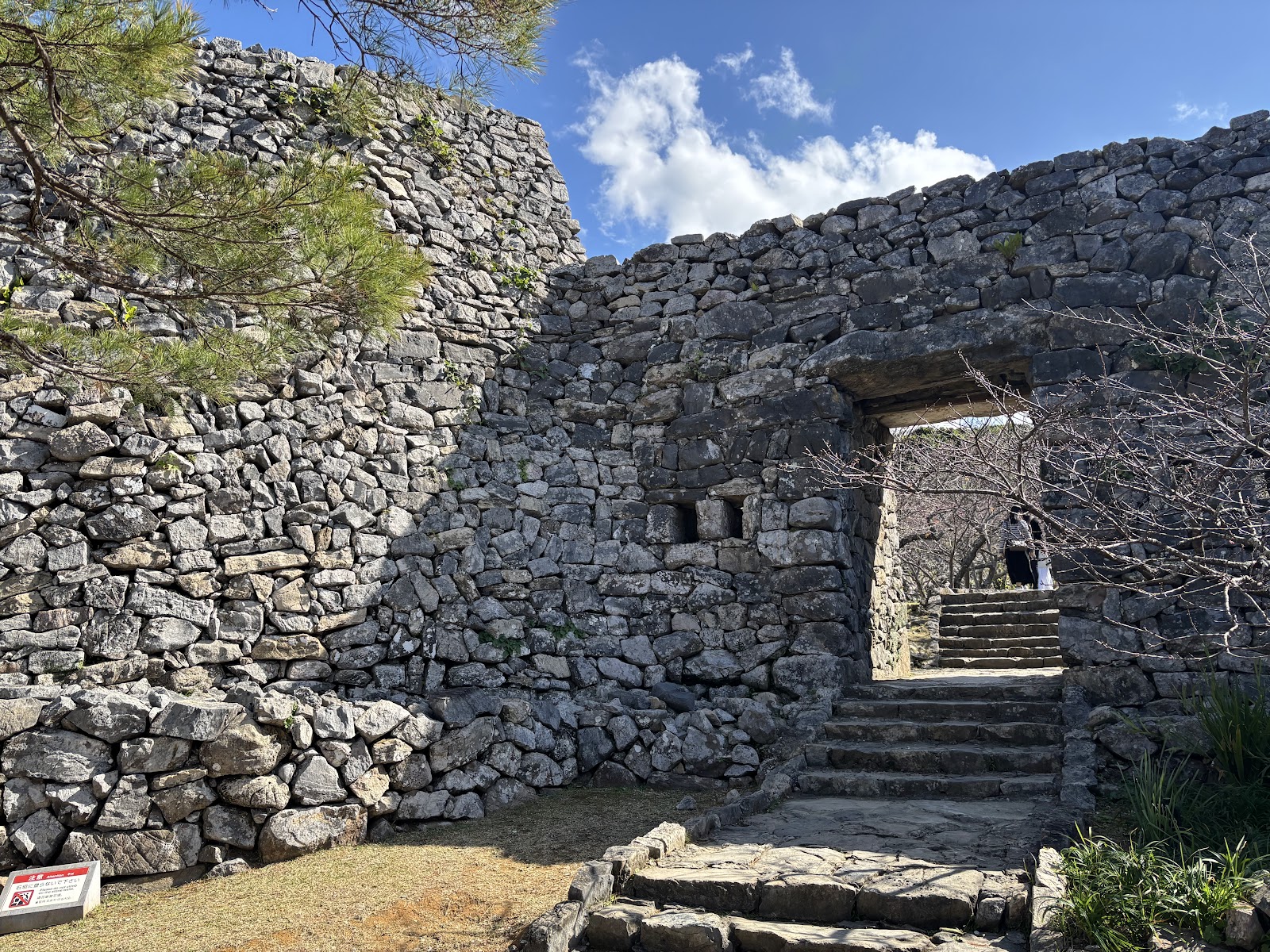
What makes the walls here worth a close look is the stone. While most Okinawan castles were built from soft, easily carved Ryukyu limestone, Nakijin’s builders instead quarried hard Paleozoic limestone straight from the hillside, stacking the unprocessed rock by hand in the ancient nozurazumi technique — a method of construction that predates similar walls elsewhere in Japan by roughly two to three centuries. Enter through the restored Heiromon gate and follow the cobblestone road inward; its deliberately narrow, winding path was a defensive choice, built to slow down any invading force long enough for defenders on the walls above to respond.
Time your visit for late January through early February and you’ll catch something few other ruins in Japan can offer: the Nakijin Gusuku Cherry Blossom Festival, when the Okinawan hikanzakura — the earliest-blooming cherry trees in the country — bloom deep pink against the grey stone walls. After dark, the blossoms and ramparts are lit up with Ryukyu glass lanterns for a genuinely otherworldly atmosphere, with traditional Okinawan dance, live music, bullfighting, and a farmers’ market running through the festival period.
Even outside festival season, the climb is worth it for the view alone: the ruins sit roughly 100 meters above the coast, with sweeping views out over the East China Sea. Wear decent shoes for the uneven stone paths, and pair the visit with the nearby Nakijin Village Historical and Cultural Center to see artifacts — including 14th- and 15th-century Chinese ceramics and Goryeo celadon — recovered from the site.