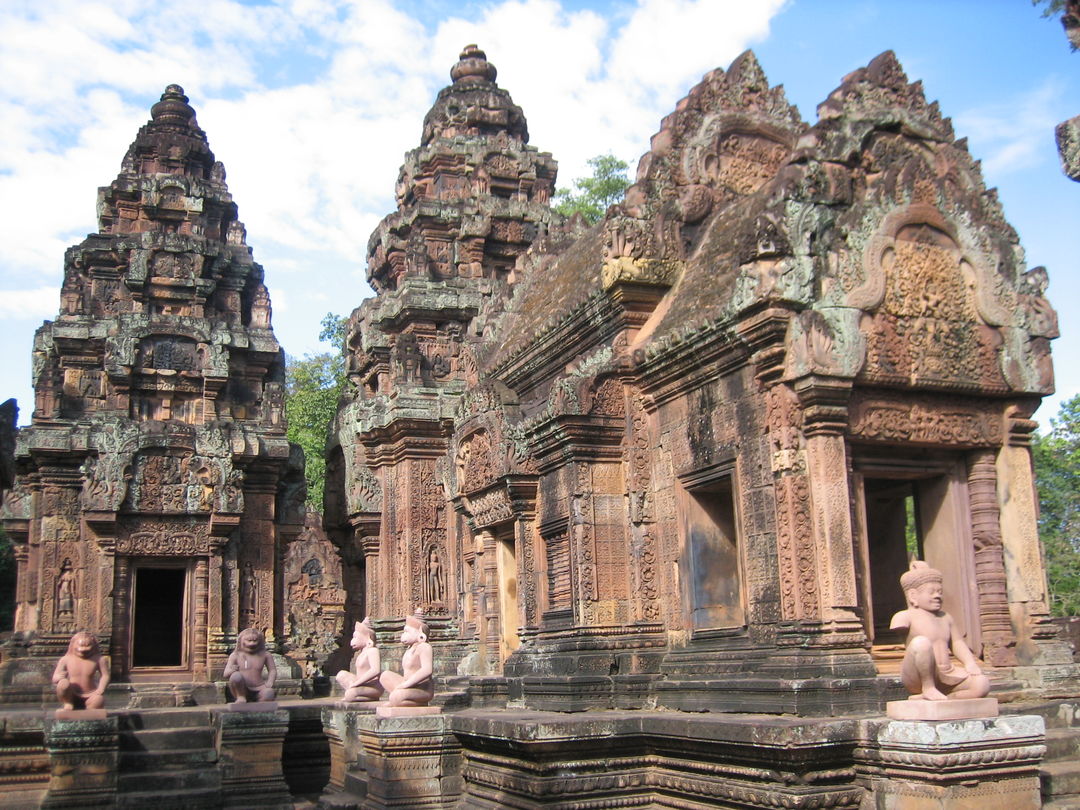
Banteay Srei Temple rewards travelers who slow down. Set within the Angkor landscape north of Siem Reap, this compact 10th-century Hindu temple does not overwhelm you with the vast scale of Angkor Wat; instead, it pulls you close to the stone. Its warm pink-red sandstone and remarkably intricate carvings make the walls, lintels and pediments feel less like distant ruins and more like a gallery of Khmer craftsmanship waiting to be read at walking pace.
The temple was consecrated in 967 CE and dedicated to Tribhuvanamaheshvara, a form of Shiva. Look carefully at the carved pediments rather than rushing from gateway to gateway: stories drawn from Hindu tradition appear in the stone, including Ravana shaking Mount Kailasa and scenes involving Shiva, Kama, Indra and Kamsa. You do not need to know every episode before arriving. The pleasure is in noticing how much movement, expression and detail the sculptors found in a material that can look so delicate from a distance.
Because the inner enclosure is small and the most famous carvings draw concentrated attention, this is a place to arrive with a little patience. Morning crowds can be heavier, so an early or later visit is often a more comfortable way to give the carvings the time they deserve. Bring water, wear footwear suitable for uneven heritage-site paths, and keep your camera work secondary to the details directly in front of you. The best moments here are often the quiet ones: a pattern around a doorway, a figure at the edge of a lintel, or the changing color of the sandstone in the light.
For travelers exploring Angkor, Banteay Srei is a worthwhile detour when you want a more intimate encounter with Khmer art. Pair it with the better-known temples if your schedule allows, but do not treat it as a quick checkbox. Its scale is precisely why it stays with people: every close look reveals another reason to linger.