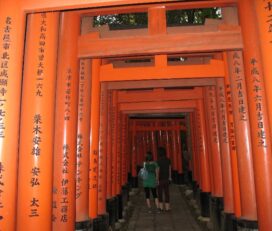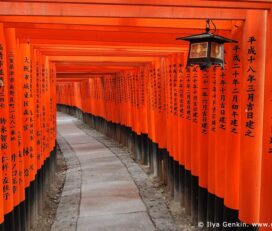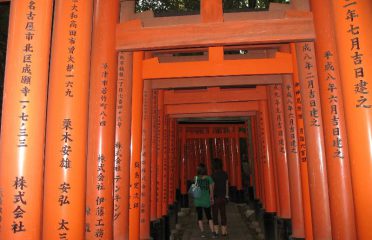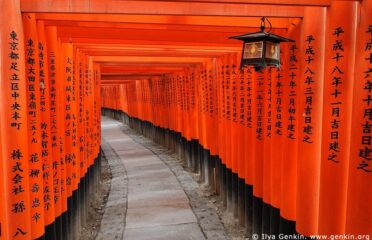
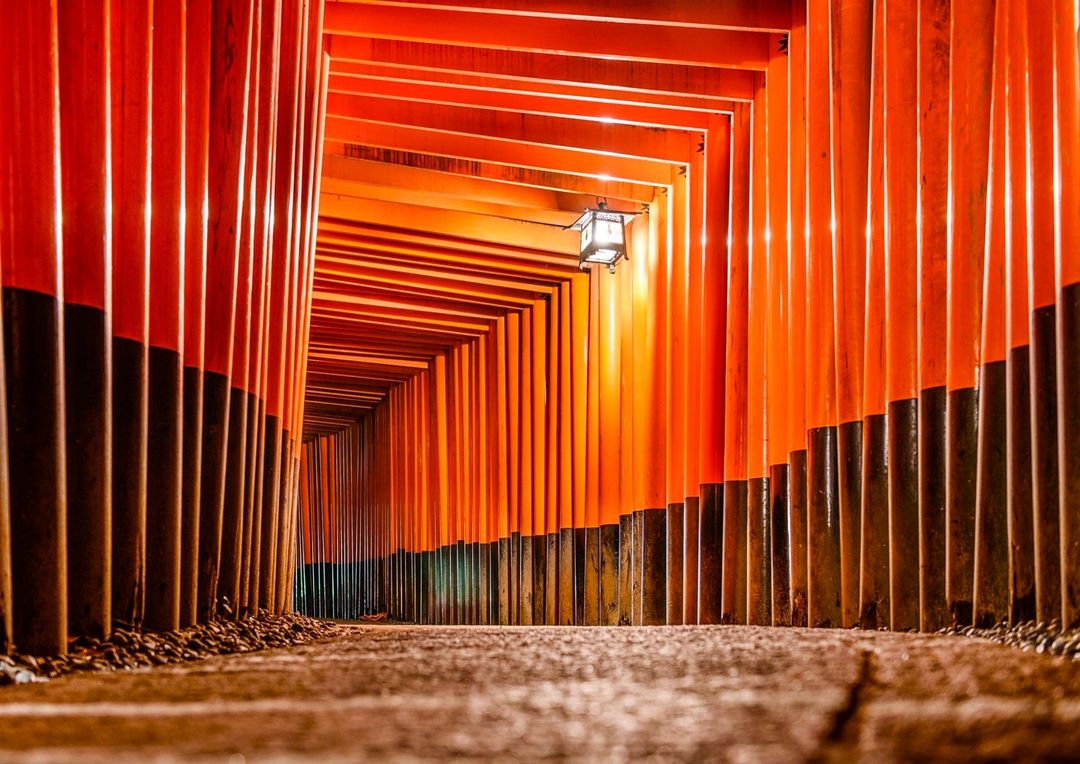
You’ll hear Fushimi Inari before you fully grasp the scale of it: footsteps on gravel, the occasional ring of a bell at the main hall, and then the path funnels you into the Senbon Torii, a tunnel of close-set vermilion gates that’s become one of the most photographed sights in Japan. Go early morning or in the last hour before dusk if you want that tunnel to yourself for even a minute; midday brings crowds that make the famous shot nearly impossible.
This is the head shrine of Inari, the kami of rice, agriculture, and by extension business prosperity, and it’s been here since 711 CE, founded by the Hata clan nearly a century before Kyoto itself became Japan’s capital. The current main hall, the Go-Honden, dates to 1499, and the striking two-story Romon gate at the base of the hill was built in 1589 under the warlord Toyotomi Hideyoshi. Everywhere you look there are fox statues, kitsune are considered Inari’s messengers, and you’ll often see a key clenched in their mouths, symbolizing the keys to a rice granary.
The roughly 10,000 torii scattered across the complex, including the famous row of around 800 forming the main tunnel, were each donated by a business hoping for good fortune; look closely and you’ll see the donor’s name in black kanji running down the side of each post. Keep walking past the tunnel and the crowds thin out fast, the full circuit up and around Mount Inari, past countless smaller shrines and personal stone altars called otsuka, takes roughly two hours round trip and climbs to 233 meters, with far better views and far fewer tourists the higher you go.
Grab inari sushi or kitsune udon from one of the small stalls along the approach before you start climbing, both dishes use aburaage, the fried tofu Inari’s fox messengers are said to love, and they make a good, cheap bite before or after the hike. Entry is free and the grounds are open around the clock, though the shrine office itself keeps more standard daytime hours.