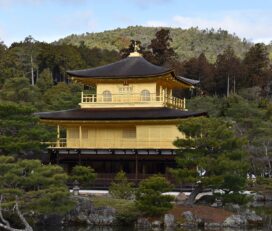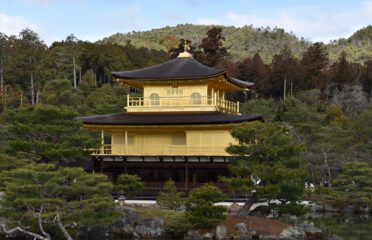
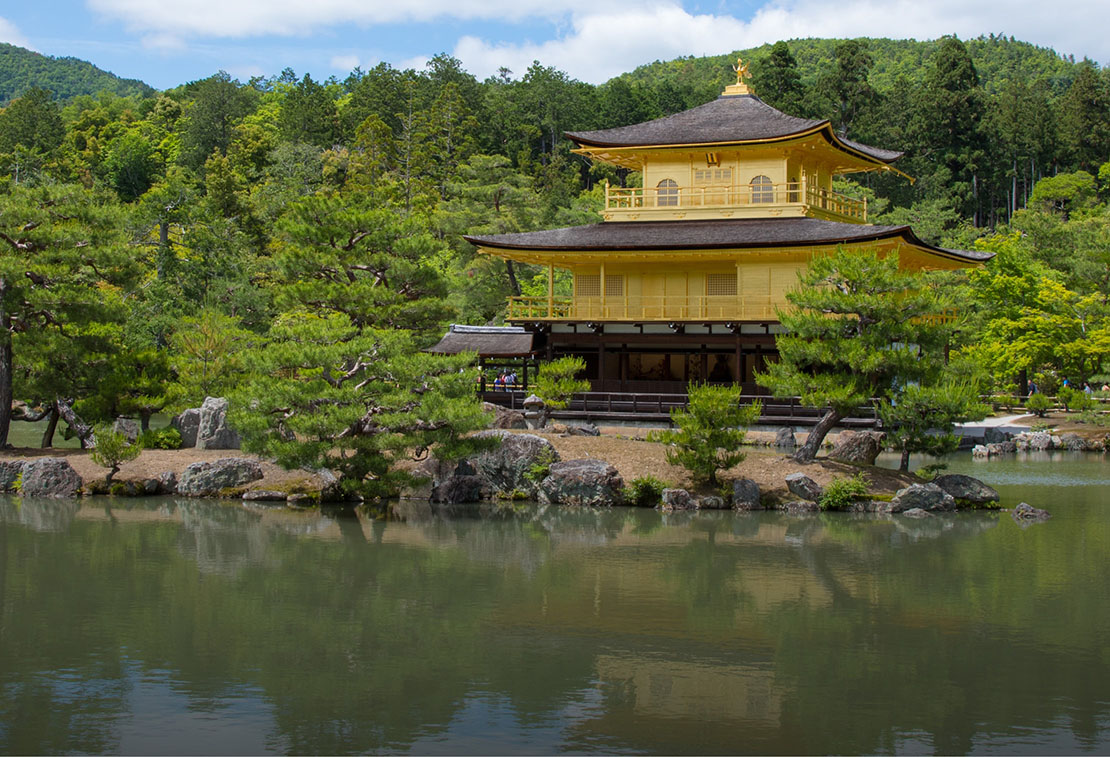
Kinkaku-ji, formally Rokuon-ji, is a Zen Buddhist temple in northern Kyoto built around its famous reliquary hall, the Golden Pavilion — a three-story structure whose top two floors are coated in gold leaf and whose reflection shimmers across the Kyoko-chi “mirror pond” in front of it. First built in 1397 as a retirement villa for shogun Ashikaga Yoshimitsu, the estate was converted into a Zen temple after his death, per his wishes, and the grounds have carried the Kinkaku-ji name ever since.
Each of the pavilion’s three floors is built in a distinct style: the ground floor follows the Heian-era shinden-zukuri palace style, the second floor uses the samurai buke-zukuri style and houses a gilded Kannon shrine, and the top floor is built as a Chinese Zen hall, capped with a bronze phoenix. The current building dates only to 1955 — the 14th-century original was burned down in 1950 by a young monk in an arson attack that later inspired Yukio Mishima’s novel “The Temple of the Golden Pavilion” — and its gold leaf was fully reapplied in 1987.
Beyond the pavilion itself, the roughly 92,000-square-meter grounds include the Anmintaku Pond, said to never run dry, the Sekkatei Teahouse added during the Edo period, and Fudo Hall, home to a statue attributed to Kobo Daishi. The walking route circles the pond for multiple vantage points on the pavilion before leading past souvenir shops and a tea garden serving matcha near the exit; visitors cannot enter the pavilion itself, since it houses Buddhist relics.
Kinkaku-ji was designated a UNESCO World Heritage Site in 1994 as part of the Historic Monuments of Ancient Kyoto. It’s open daily from 9:00 to 17:00 with no closing days, admission is 500 yen, and it’s reachable from Kyoto Station by city bus (lines 101, 204, or 205) in about 40-45 minutes, or via the Karasuma subway line to Kitaoji Station followed by a short bus or taxi ride.